

Escaping the Grind
How I've been brain-scrubbing these past two months

It’s been almost two full months since I announced giving myself space from Substack to focus on other projects and endeavors. In that time, I’ve realized how much I enjoyed the peace and quiet away from the screen and the constant buzz online. It’s given me greater clarity to realize what it is I actually care about and how my process with the craft of writing, and the act of living, works for myself.
In my new routine, there are a number of things I’ve returned to, picked up, or addressed that being consistently online and invested in trying to figure out how to optimize everything to get noticed prevented me from achieving.
Back to Basics
I haven’t stopped writing, of course. It’s not something I will or can so easily give up. As Garth Marenghi says, “[I]f you took away my paper, I would write on my heart. If you took away my ink, I’d write on the wind…”
Instead of sacrificing craft and effort to meet the weekly grind of posting on Substack, I’ve opted for a slower approach to writing by turning mainly to handwriting drafts for story I intend on selling to editors and publishers this year. Last year, I’d made a post about handwriting, and all those things I mentioned still hold true, even more so than I remembered. I attempted to handwrite my drafts a little more last year while I was still in the grind, but all that I wrote would need to quickly be drafted into a Substack post with just a few passes on edits. Admittedly, I’ve only worked on one “short” story so far since January, and it came out to around 16,000 words without the notes I scribbled in the margins of my journal. Although it’s gone well over the mark of the market I want to submit it to, having such a project to work on has opened up new possibilities for continuing with the characters and setting I’ve laid out. Not promising anything yet, but simply getting to be so close to the work without the filter of the screen has helped me imagine further projects beyond the one-and-done nature of online content.
My main writing times are in the morning when I’m at the gym and later in the afternoon. I’ll write between sets, even if it’s just a sentence at a time; I go without music so it’s easier to think and imagine scenes and characters while I’m exercising so I can put them, mostly fresh, onto the page. When I’m writing at home in the afternoon, I’ll hide my phone in a pantry I rarely use and then just write until dinnertime, always striving to reach a point where I can use that one but of Hemingway’s advice on stopping when I know exactly what will happen next.
One of the tools that has helped me with writing is this mini writing desk that fits on your lap. It’s a bit old, the side drawers need a little jiggling to open correctly, and there’s a long crack in the main board, but it is perfect in every way for my craft. I can prop up the board at different angles, which is ideal as I move further and further down the page.
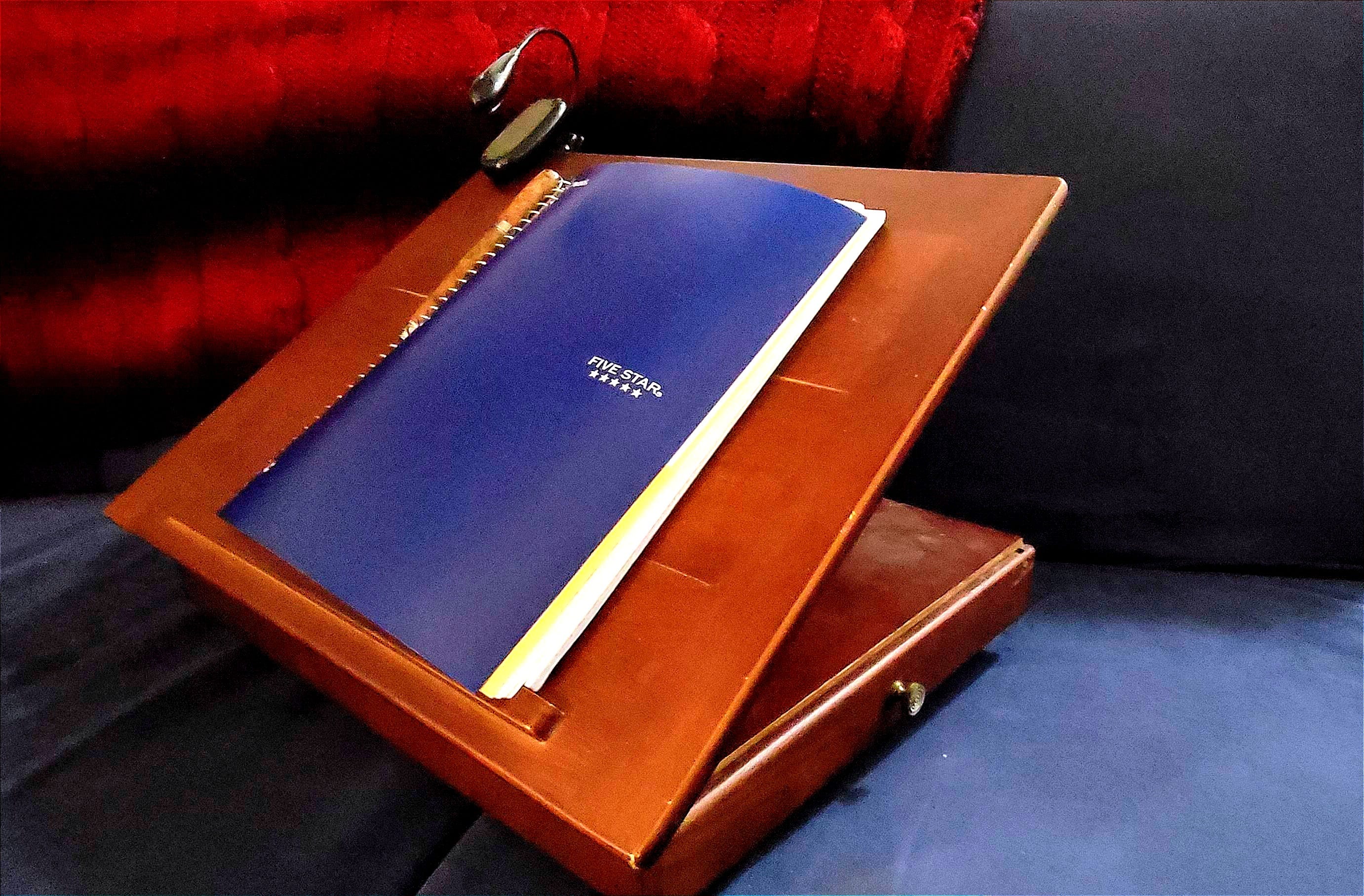
It’s also the perfect thickness to put my reading lamp at the top for whenever the sun decides to hide early in the evening. The drawers on either side too help with storing important tools like gel pen refills.
I haven’t done away with digital writing completely, as I still need a word processor to create manuscripts for sending into publishers. To that end, I got Scrivener as a gift this Christmas. It’s changed my life considerably and blows any AI tools or “workflow optimizers” hawked by billion-dollar corporations out of the water and into the stratosphere. It’s an old school sort of program that is unintrusive and simply lets writers write without worrying about being spied on or unnecessary features getting in the way of finishing projects. I’m sure most people on Substack are at least familiar with it, so I won’t bore folks with the details.
One of the major features of it I love and always wanted a solution for was keeping all my drafts of a story in one place. Before, I’d have to open several different files from File Explorer alongside whatever current draft I was working on and flip between those. Since Scrivener lets you upload documents to whatever project you’re working on, it’s completely fixed the problem of having to clog up my computer’s memory with a bunch of open documents. It’s exactly the type of digital tool I needed for the craft and can see myself using it for years to come.
Picking up Something New
Once I’m done writing in the evening, unless it’s for a specific reason, I’m done. Full stop. No dinner breaks, no burning the midnight oil, nothing. For those hours before bed, over the past two months, I’ve been dedicating them to finally building a Grey Knight kit I’d purchased in 2023.
I got into Warhammer 40k at the end of grad school, starved for something completely different, and just figured I would see what 40k was all about. I got a Grey Knights boarding patrol and didn’t touch it until just this year. And I’m glad I finally cracked it open…


It’s a bit too cold to prime any of them, so for now, I’ve just got them all built and ready for when the thaw comes.
The process has scratched the same itch I’d felt years and years ago when I first started building Legos. And the 40k universe itself, I feel, has inspired me incredibly in my personal hobby endeavors and even in philosophy in some ways. I’ve drawn some comparisons to Nietzsche’s concept of the Super Man with the Imperium of Man’s efforts to conquer the stars. The art, music, and other forms of media fans of the franchise have been inspired to create is something I have yet to see to the same extent elsewhere.
The Other Little Things
Finally, since coming off the grind, I’ve just been noticing a lot of smaller things that help bring me back to real life. Chores like cleaning, washing dishes, making my bed, and sorting my physical space out feel a lot easier to do. When I was on the content grind, I felt so obligated to spend as much time as possible simply online, looking for ways to optimize my posts, grow my brand, and stay “connected” that I neglected taking some time to make sure my house was in order. It’s just revealed to me that it wasn’t healthy in the first place to chase after something that wasn’t real to begin with.
Even just existing, day-in-day-out is more pleasurable. No longer do I have to occupy my mind with thinking about the next post, scheduling my days and weeks around just churning out content. I can spend my commute, workouts, and evenings thinking about nothing in particular if I want to, and that’s good enough for me.
Going Forward
I think, going forward, Substack remains among my lower priorities. There are just a lot more things I’m interested in doing in real life now that coming back in more than a monthly capacity seems a bit excessive. My life feels more balanced and present without the steady stream of churning out content on a weekly basis or shallowly consuming it in the intervals where I wasn’t drafting posts.
This is just how things are for me now. Don’t take this as some writing or life advice piece, just a long note about what I’m up to without going into an influencer-style, day-in-the-life. I’m still interested in scholarly reviews and will drop the next one…whenever I feel like it. I still have the rest of Outsiders to get through and it is a show all right…
I’m so glad that rethinking and thus reorganizing your life is working well for you. Never give up! Keep up the search and the challenge of exploration. So proud of you!
Im so glad your screen-less routine is working for you. It's amazing. I appreciate you sharing. I haven't gone so far as writing by hand again. How does handwriting impact the work flow? I am such a fast typer, I wonder if my hand work be too slow for my brain.
Do you type up the drafts in scrivener once the draft is done? I use the same program, it really is great!